
Picture someone who drinks three regular colas a day and has decided that’s too many. Stopping overnight feels like a wall. So they look at the cooler and see a row of zero sugar soda, and wonder whether that’s a cheat or a sensible first step.
It can be a sensible first step. Used on purpose, for a limited time, with an exit plan, zero sugar soda is a reasonable bridge. Used as a permanent “healthy” swap, the evidence gets thinner. This post is about the first use, and being honest about the second.
Quick answer: Zero sugar soda lists 0 g sugar and 0 calories on the label, so swapping it for regular soda removes the sugar from that drink. Harvard’s Nutrition Source calls diet drinks a possible short-term substitute. It’s a stepping stone, not a destination, and the long-term research on sweeteners is still inconclusive.
Key takeaways
- A 12-ounce regular Coke lists 39 g of sugar; Coca-Cola Zero Sugar lists 0 g.
- Terms like “zero sugar,” “zero calorie” and “low calorie” are label wording. The Nutrition Facts panel and ingredient list are what to read.
- A gradual swap, one can at a time, can be easier to stick to than a hard stop.
- Zero sugar soda still contains sweeteners and sometimes caffeine, so set an end date.
What does zero sugar soda (sugar free soda) actually change on the label?
The sugar, mostly. Coca-Cola’s US site says a 12-ounce can of Coke has 140 calories and 39 grams of sugar. Its Coca-Cola Zero Sugar page lists 0 calories and 0 g total and added sugars for a 12 fl oz can.
To put 39 g in context, the FDA’s Daily Value for added sugars is 50 g. One regular can is therefore most of the reference amount for a whole day. Harvard’s Nutrition Source describes a typical can of sugary soda as holding the equivalent of 7 to 10 teaspoons of sugar.
 Sources: Coca-Cola US product pages (12 fl oz) and FDA Nutrition Facts label guidance (Daily Value 50 g added sugars).
Notice what hasn’t changed, though. Caffeine: 34 mg per 12 oz for both Coke and Coca-Cola Zero Sugar on Coca-Cola’s pages. Sodium on the Zero Sugar can: 40 mg, or 2% of the Daily Value. So zero sugar soda isn’t a caffeine-light option, it’s a sugar-light one.
Zero sugar, zero calorie, low calorie: are they the same thing?
You’ll see “zero sugar soda,” “sugar free soda,” “zero calorie soda,” “low cal soda” and “diet” used almost interchangeably. In practice they’re marketing words, and the recipes behind them differ from brand to brand and even within one brand.
Take sugar free coke as an example, since people search for it by that name. On Coca-Cola’s own pages: Diet Coke lists 46 mg of caffeine per 12 fl oz, while Coca-Cola Zero Sugar lists 34 mg. The ingredient lists differ too. Diet Coke’s is sweetened with aspartame; the Zero Sugar label lists aspartame and acesulfame potassium among its sweeteners. Two cans, both “zero,” not identical.
So skip the front-of-can wording and look at three things:
- Nutrition Facts: calories and added sugars. The FDA explains that 5% Daily Value or less per serving is low and 20% or more is high.
- Ingredients: which sweeteners are listed. Our diet soda without aspartame guide explains how to read that line.
- Caffeine: often given as a separate line on the brand’s site, not the can.
Is zero sugar soda a good first step away from regular soda?
Here’s where I’ll offer an opinion: for most people trying to drop a daily sugary soda habit, a short bridge beats willpower theatre. Quitting is hard enough without making every can a moral event.
The research backs a narrow version of that. Harvard’s Nutrition Source says diet drinks are “a better choice than sugar-sweetened soft drinks” on calories, and “a possible short-term substitute, best used in small amounts over a short period of time.” It cites an AHA/ADA advisory calling low-calorie sweetened beverages “a useful temporary replacement strategy” for sugary ones, and says children should avoid them long-term.
Now the limits, because they matter. The CDC notes that drinks labelled “sugar-free” or “diet” usually contain high-intensity sweeteners and that their long-term effect on weight management is uncertain. WHO’s 2023 guideline goes further and recommends against using non-sugar sweeteners to control body weight or reduce the risk of noncommunicable diseases. WHO rates that recommendation as conditional, and it excludes people who already have diabetes.
The honest summary: zero sugar soda removes sugar from the can. Whether it helps over years is an open question. That’s exactly why “temporary” is the key word.
How do I taper from regular soda to zero sugar soda?
This is the part most articles skip. A bridge needs a plan with a far bank. Here’s an example plan, using the label figures above. It is an example, so change the numbers to your own habit.
| Step | What changes | Sugar from soda per day (example) |
|---|---|---|
| Starting point | 3 regular cans a day | 117 g (3 x 39 g) |
| Weeks 1-2 | Swap 1 can for zero sugar soda | 78 g |
| Weeks 3-4 | Swap a second can | 39 g |
| Weeks 5-6 | All cans zero sugar; set a weekly allowance | 0 g from soda |
| Weeks 7 onward | Lower the allowance a little each week; swap in sparkling water | 0 g from soda |
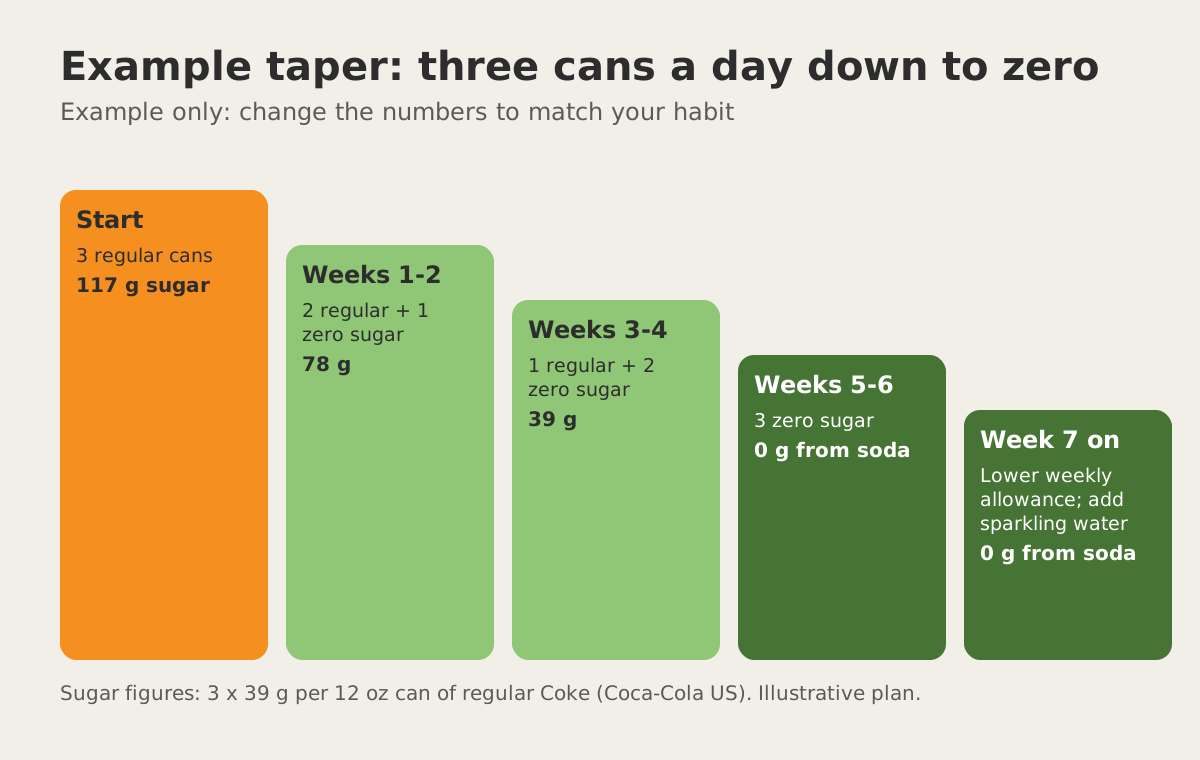 Example only. Sugar figures use 39 g per 12 oz can of regular Coke from Coca-Cola’s US site.
Three rules make this work better than it sounds on paper.
Swap the same moment first. If your first can is the one at lunch, swap that one. Change one moment at a time, so you can tell what’s working.
Put a date on the last step. “Until the end of next month” is better than “for a while.” The aim isn’t to replace one habit with a permanent slightly-different one.
Plan for the slip. If you drink a regular can on a hard day, that’s one day, not a reset. Go back to the step you were on.
If you’d rather work out your why before your how, how to quit soda is the full plan, and benefits of quitting soda covers what people notice. This post is just the middle step.
Can an app help with the taper?
Doing arithmetic on a napkin works for about nine days. After that you forget what week you’re on.
FizzFree, a quit soda tracker from FizzFree Labs, has a Taper Dial for exactly this. You set a weekly allowance and lower it a little at a time instead of stopping overnight. The Sugar Jar stacks up the sugar you skipped as cubes, and a daily check-in shows where you are today. There’s no streak to lose, so a fizz day doesn’t wipe out the weeks before it. See how it works for the full setup.
What are the limits of zero sugar soda?
Let me be straight about what this approach can’t promise.
- It doesn’t change the habit. If your afternoon can is about the 3 pm slump, a zero sugar can answers the sugar, not the slump. Name the moment and give it a swap.
- It isn’t a health drink. Harvard’s top picks are water, and coffee or tea without added sweeteners.
- Sweetness stays high. WHO’s guidance suggests reducing sweetness in the diet overall, not just switching its source.
- Some people shouldn’t use it. People with phenylketonuria are told to avoid aspartame, which is why labels carry the phenylalanine statement.
Frequently asked questions
Is sugar free coke the same as zero sugar soda? Close, but not identical: Diet Coke lists 46 mg caffeine and Coca-Cola Zero Sugar 34 mg per 12 oz, and their sweeteners differ.
Is zero sugar soda the same as diet soda? Not exactly. Both can list 0 calories and 0 g sugar, but recipes differ: on Coca-Cola’s pages Zero Sugar has 34 mg of caffeine per 12 oz and Diet Coke has 46 mg.
How much sugar is in a can of regular Coke? Coca-Cola’s US site says a 12-ounce can has 39 grams of sugar and 140 calories.
Is zero sugar soda healthy? It’s lower in sugar than regular soda, but not a health drink. Harvard sees it as a possible short-term substitute.
How long should I use zero sugar soda as a step down? There’s no official number. Harvard says short periods and small amounts; many people choose a few weeks.
Can I stop drinking zero sugar soda too? Yes. Use the same taper: fewer cans per week, with a swap for each moment.
I'm John Osakwe, founder of FizzFree Labs, the company behind the FizzFree app for quitting or cutting down soda and energy drinks. I also run Etest Tech Hub in Lagos, Nigeria, where we build mobile apps.
FizzFree is a habit tracker and not medical advice. If you have a health condition or take medication, talk to your doctor before changing what you drink.