
It’s day two without your usual coffee, cola or energy drink. It’s two in the afternoon. You’ve read the same sentence four times, your temples are dull and tight, and you’re snapping at people who did nothing wrong. Is that caffeine withdrawal, or just a bad Tuesday?
Usually it’s both, and the way to tell is to match what you feel against the caffeine withdrawal symptoms researchers have actually checked. Not every symptom people blame on caffeine holds up. Some do, very well.
Quick answer: The best-supported caffeine withdrawal symptoms are headache, fatigue, low energy, drowsiness, poor concentration, irritability, low mood and a foggy head. Flu-like aches, nausea and muscle stiffness are likely too. They typically start 12 to 24 hours after your last dose and fade within days.
Key takeaways
- A large review found 10 symptoms with solid evidence, and 3 more that are likely.
- About half of people in experimental studies got a headache; about 1 in 8 had real distress or trouble functioning.
- Heavier daily use tends to mean stronger symptoms, but stopping as little as 100 mg a day caused them in studies.
- Withdrawal is unpleasant, not dangerous, according to the FDA. Severe or unusual symptoms are a reason to call a doctor.
What are the symptoms of caffeine withdrawal?
The most useful source here is a 2004 review in the journal Psychopharmacology by Laura Juliano and Roland Griffiths. They went through 57 experimental studies and 9 surveys and sorted 49 different reported symptoms by how well each one stood up. Ten passed their validity tests, and three more were judged likely.
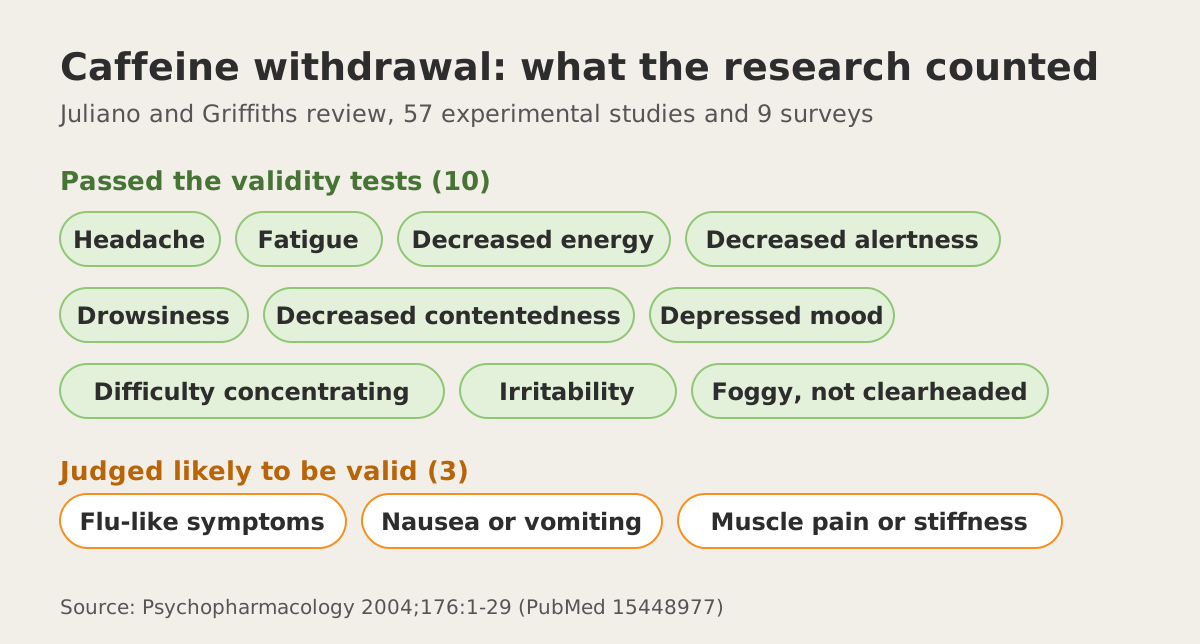
The 13 symptom categories from the Juliano and Griffiths review, split by strength of evidence.
Here they are in plain English, along with what they tend to feel like:
| Symptom (as the review names it) | What it can feel like | Evidence level |
|---|---|---|
| Headache | Dull, throbbing or pressure-like pain | Validated |
| Fatigue; decreased energy | Heavy limbs, nothing feels easy | Validated |
| Decreased alertness; drowsiness | Heavy eyelids, nodding off | Validated |
| Difficulty concentrating; foggy or not clearheaded | Rereading, losing your train of thought | Validated |
| Irritability | Short fuse over small things | Validated |
| Depressed mood; decreased contentedness | Flat, a bit gloomy, less pleased by things | Validated |
| Flu-like symptoms | Achy, slightly off | Judged likely |
| Nausea or vomiting | Queasy stomach | Judged likely |
| Muscle pain or stiffness | Tight neck and shoulders | Judged likely |
MedlinePlus, from the US National Library of Medicine, gives a shorter list for everyday readers: headaches, drowsiness, irritability, nausea and trouble concentrating. Cleveland Clinic adds muscle pain and tiredness to its own list and describes the feeling as “shaky, irritable and headachey.”
How common are caffeine withdrawal effects?
Common, but not universal, and that’s the part many guides skip.
In the experimental studies in the review, the incidence of headache was 50 percent. The share of people with what the authors call clinically significant distress or functional impairment was 13 percent. So about one in two gets a headache, and roughly one in eight finds it hard to get on with the day.
Dose matters. The review found that both how often and how severe the symptoms were generally rose with daily intake, yet abstaining from doses as low as 100 mg a day produced symptoms. According to a Johns Hopkins press release about the paper, 100 mg is about one small cup of coffee. The same release notes that 80 to 90 percent of adults in North America report regular caffeine use, with an average of about 280 mg a day among users.
That’s why your colleague who drinks one tea can quit with a shrug while you, on four large coffees, feel flattened.
How do I tell withdrawal from something else?
Honest answer: you can’t be certain from a list. But two things point toward caffeine.
Timing. The review reports that symptoms typically begin 12 to 24 hours after the last intake. If it started a week after you stopped, or got worse after two weeks, look elsewhere.
Company. Withdrawal symptoms travel together: headache plus fatigue plus a short temper. One isolated odd symptom, such as chest pain or a rash, isn’t on any list above.
A habit worth building is writing it down. Five words a day (“headache, tired, grumpy, 3 pm”) will show you whether things are getting better or worse far more clearly than memory will.
What does caffeine craving feel like?
Cravings aren’t on the review’s validated list as a separate item, but it does make a point that explains them. The authors report that avoiding withdrawal plays a central role in habitual caffeine use. In other words, part of why you reach for the cup is to stop yourself feeling bad. That loop can feel like a craving, and it’s strongest at the same times each day.
Naming those times helps. FizzFree’s Fizz Map is built for this: you name the moments you reach for a drink, such as the 3 pm slump, and it sends a quiet nudge 10 minutes before. If caffeine from energy drinks is your habit, FizzFree’s energy drinks mode also tracks the caffeine you skip. It is a habit tracker, so it won’t treat anything. It just makes the pattern easy to see.
How do you make caffeine withdrawal side effects milder?
You can’t skip withdrawal with willpower, but you can usually shrink it by going slowly. Both the FDA and Cleveland Clinic say the same thing: if you drink caffeine daily and want to cut back, do it gradually. The FDA’s own wording is that withdrawal “isn’t considered dangerous but can be unpleasant.”
Cleveland Clinic’s suggestions are practical:
- Estimate how much caffeine you actually have. It lists about 140 mg for a mug of filtered coffee and about 40 mg for a can of soda, and says to check labels.
- Drop one cup, or switch black tea to green or white tea.
- If you drink espresso, mix in decaf, starting with half or a quarter, then reduce further every few days.
- Set a daily cutoff. Cleveland Clinic says medical professionals recommend stopping caffeine by 2 p.m.
- Drink enough water, since it says dehydration is often behind low energy.
- Be careful with caffeinated pain relievers: it warns they continue the dependence. Ask a pharmacist or your doctor about any pain relief.
I think the 2 p.m. rule is the most underrated one. It costs you almost nothing and it protects your sleep, which is when tired mornings are either made or fixed. We cover the sleepy side in tired after quitting caffeine.
How long do the symptoms last?
The review reports that peak intensity usually falls 20 to 51 hours after the last dose, and the whole episode runs 2 to 9 days. MedlinePlus says the symptoms usually go away after a couple of days. Because the ranges differ a little, treat them as a window, not a promise. The full breakdown is in our caffeine withdrawal timeline, and if headache is your main problem, see caffeine headache.
Planning to stop in one go? Read quitting caffeine cold turkey first, and see how FizzFree works if you want a calm daily check-in alongside it.
When should you call a doctor about caffeine withdrawal?
Getting it wrong in either direction is a mistake: you shouldn’t panic over a headache, and you shouldn’t brush off something that isn’t on the list.
Call a doctor if:
- symptoms are severe, keep getting worse, or run well past the ranges above
- you have a sudden, severe headache, or one with fever, confusion, weakness or vision changes
- mood is very low, or you have thoughts of harming yourself
- you can’t keep fluids down
- you’re pregnant, take medication or have a condition such as high blood pressure or a sleep disorder. MedlinePlus says to check with your provider about whether to limit or avoid caffeine in those situations.
FAQ
Is caffeine withdrawal real? Yes. The Psychopharmacology review concluded the syndrome is well characterized, and MedlinePlus lists it for people who regularly consume caffeine and suddenly stop.
Can caffeine withdrawal make you feel depressed or anxious? The review found depressed mood and decreased contentedness among the validated symptoms, along with irritability. If low mood is heavy or lasts, tell a doctor.
Does decaf cause or prevent withdrawal? Decaf still has a little caffeine: the FDA lists 2 to 15 mg per 8 ounces. Cleveland Clinic suggests blending it in as a step down.
Do I get withdrawal if I only drink one cup a day? Possibly. Symptoms appeared after stopping 100 mg a day in the studies, though many people notice little.
When should I see a doctor? For severe, worsening or unusual symptoms, or any sudden severe headache.
Sources

I'm John Osakwe, founder of FizzFree Labs, the company behind the FizzFree app for quitting or cutting down soda and energy drinks. I also run Etest Tech Hub in Lagos, Nigeria, where we build mobile apps.
FizzFree is a habit tracker and not medical advice. If you have a health condition or take medication, talk to your doctor before changing what you drink.