
12 to 24 hours. 20 to 51 hours. 2 to 9 days. Those three ranges are the whole caffeine withdrawal timeline as the best review we have measured it, and they’re worth memorising before you quit, because they turn “how long will I feel like this?” into something with an end date.
This page walks through those windows in order, shows what each stretch usually feels like, and is honest about where the evidence stops.
Quick answer: In a review of 66 studies, caffeine withdrawal symptoms typically began 12 to 24 hours after the last dose, peaked at 20 to 51 hours, and lasted 2 to 9 days. MedlinePlus says symptoms usually go away after a couple of days. Heavier daily use tends to mean a stronger, longer episode.
Key takeaways
- Onset 12 to 24 hours, peak 20 to 51 hours, total 2 to 9 days (Juliano and Griffiths review).
- These are typical ranges, not promises: dose and the person both change the picture.
- Caffeine itself takes up to 10 hours to clear your blood, so the first symptoms can’t appear instantly.
- Cutting back slowly is the usual way to soften the peak.
How long does caffeine withdrawal last?
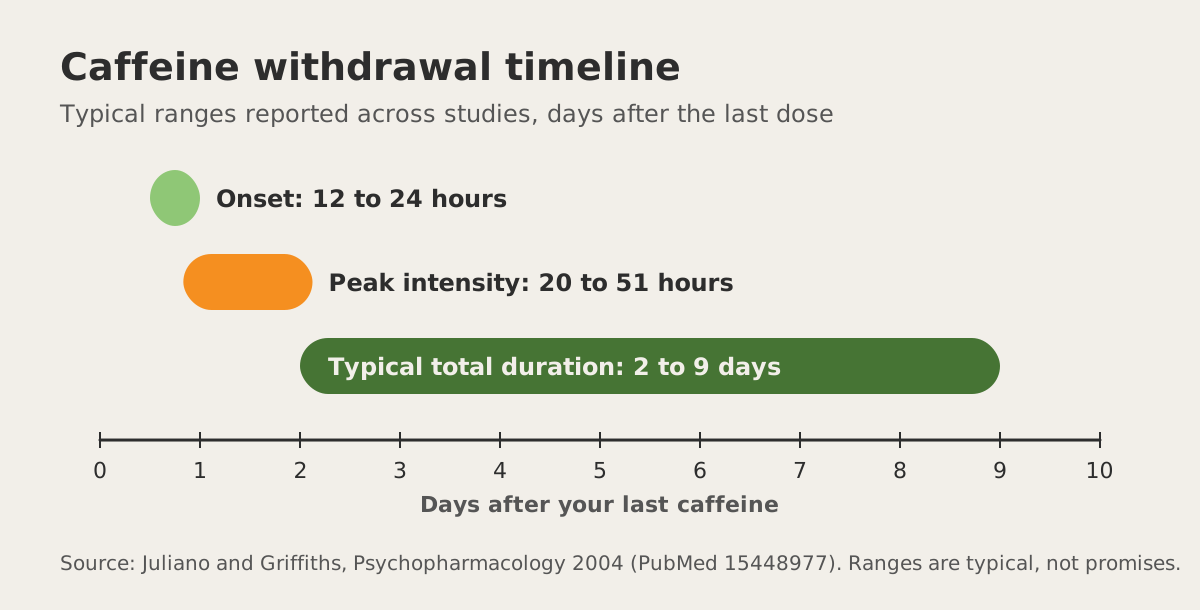
The three windows reported by Juliano and Griffiths (2004), laid over a 10-day axis.
The numbers come from a 2004 review in Psychopharmacology by Laura Juliano and Roland Griffiths. They analysed 57 experimental studies and 9 surveys, and report that symptoms “typically” start 12 to 24 hours after stopping, reach peak intensity at 20 to 51 hours, and last 2 to 9 days.
Notice the word typically. These are the middle of a spread, and a window of 2 to 9 days is wide on purpose. Because the review links higher daily doses to stronger symptoms, a small daily habit plausibly sits nearer the short end and a heavy one nearer the long end.
MedlinePlus, which is run by the US National Library of Medicine, puts it more briefly: symptoms usually go away after a couple of days. That fits the low end of the range.
What happens hour by hour and day by day?
Here is a plain-language map built from those ranges. The symptom names come from the review and MedlinePlus; the “what you might notice” column is my own summary of them, not a measurement.
| When (after your last caffeine) | What the sources report | What you might notice |
|---|---|---|
| 0 to 12 hours | Caffeine is still leaving your body. Cleveland Clinic says half remains after about six hours and it can take up to 10 hours to clear completely. | Often nothing yet, or a first yawn at your usual time. |
| 12 to 24 hours | Typical onset of symptoms. | A dull headache, a bit of a fog, a slightly short temper. |
| 20 to 51 hours | Typical peak intensity. | The roughest stretch: headache, tiredness, trouble concentrating. |
| About day 3 to day 9 | The tail of the typical 2 to 9 day window. | Symptoms easing at different speeds. |
| Beyond the window | Not described by the sources I opened. | Worth a conversation with a doctor if it’s still bad. |
One detail I like: the peak starts at 20 hours, not 12. If you quit on a Monday night, your worst hours land on Wednesday, probably at work. Plan the first weekend or a lighter week, if you can.
When do caffeine withdrawal headaches stop?
Headache gets its own section because it’s the symptom people dread. In the experimental studies in the review, the incidence of headache was 50 percent. The review gives one duration for the syndrome overall; I couldn’t find a separate headache duration in the sources I opened, so I won’t invent one.
A practical reading: expect headache, if it comes, around the same hours as the peak, and expect it to ease as the whole episode winds down. For what it feels like and what to do about it, see our guide to the caffeine headache.
Why does the range vary so much between people?
Dose is the biggest lever. The same review found that the incidence or severity of symptoms generally rose with daily dose, and that stopping as little as 100 mg a day produced symptoms. According to the Johns Hopkins press release, 100 mg is about one small cup of coffee.
How much are you really having? The FDA says it cited 400 mg a day as an amount not generally associated with negative effects, and that amounts in drinks vary a lot: 23 to 83 mg in a 12-ounce caffeinated soft drink, 113 to 247 mg in a 12-ounce regular brewed coffee, and 41 to 246 mg in a 12-ounce energy drink. So “I only have a couple” can mean very different things. Our comparison of coffee versus soda caffeine lays the sources side by side.
Other things plausibly matter, such as how suddenly you stop and what else is going on in your life, but the sources I opened don’t put numbers on them, so I’ll leave them as questions.
Is a “caffeine detox” a real thing, and does it have a different timeline?
People search “caffeine detox timeline” and “caffeine detox how long,” so I’ll answer directly. Cutting back caffeine is not a medical detox, and nothing here treats your body or cleans it of anything. What the review describes is an adjustment: your body is used to having caffeine and has to settle without it. The FDA says that withdrawal isn’t considered dangerous but can be unpleasant.
The timeline above is the same whatever you call it.
How do you get through the peak without making it worse?
You can’t delete the timeline. You can shape it.
- Taper if you can. The FDA says that if you drink caffeinated beverages daily and want to cut back, it’s best to do so gradually. Cleveland Clinic suggests one fewer cup, a swap to green or white tea, or mixing decaf into your coffee, starting with half or a quarter and reducing every few days.
- Choose your peak. If you’re stopping outright, line up hours 20 to 51 with a quieter stretch.
- Set a 2 p.m. cutoff on any caffeine you still have. Cleveland Clinic says medical professionals recommend it so caffeine clears before bed.
- Drink water. Cleveland Clinic notes that dehydration is often why people lack energy.
- Skip caffeinated painkillers. Cleveland Clinic warns they continue the dependence. Ask a pharmacist or doctor about pain relief for anything beyond a mild headache.
- Log it. A one-line daily note (“day 2, headache, tired”) shows the curve bending.
If sodas are your caffeine, a daily check-in can hold that log. FizzFree is a quit soda tracker built around one calm check-in a day: clean days pop bubbles, and there’s no streak to lose. Its Taper Dial lowers your weekly allowance step by step, which suits the gradual approach above, and its energy drinks mode tracks the caffeine you skip.
If you’re weighing a clean stop against a slow one, quitting caffeine cold turkey covers that choice, and caffeine withdrawal symptoms explains each symptom. See how FizzFree works for the app’s six steps.
Can it go on longer than 9 days?
Possibly, in the sense that individuals vary, and 9 is the top of a typical range rather than a hard stop. But the sources I opened don’t report weeks or months of caffeine withdrawal, so if you’re deep into week two and still feel awful, the sensible move isn’t to assume it’s caffeine. Sleep problems, stress, illness and medication can all cause the same complaints. A doctor can sort that out. This is especially true if you take medication or have a condition such as high blood pressure or a sleep disorder, which MedlinePlus lists as reasons to check with your provider about caffeine.
FAQ
How long does caffeine withdrawal last? Typically 2 to 9 days in the 66-study review. MedlinePlus says symptoms usually go away after a couple of days.
When do caffeine withdrawal symptoms peak? At 20 to 51 hours after the last dose, roughly the second day.
How long do headaches from caffeine withdrawal last? The sources give 2 to 9 days for the whole syndrome rather than a separate headache figure.
Is a caffeine detox timeline the same as a medical detox? No. It’s a short adjustment period, and the FDA says withdrawal isn’t considered dangerous but can be unpleasant.
Can caffeine withdrawal last for weeks or months? The sources I opened report days. If it goes longer, talk to a doctor.
Sources
- A critical review of caffeine withdrawal (Juliano and Griffiths, Psychopharmacology, 2004), PubMed
- Caffeine withdrawal recognized as a disorder, Johns Hopkins press release via ScienceDaily
- Caffeine, MedlinePlus (NIH)
- How to Quit Caffeine, Cleveland Clinic
- Spilling the Beans: How Much Caffeine Is Too Much?, FDA

I'm John Osakwe, founder of FizzFree Labs, the company behind the FizzFree app for quitting or cutting down soda and energy drinks. I also run Etest Tech Hub in Lagos, Nigeria, where we build mobile apps.
FizzFree is a habit tracker and not medical advice. If you have a health condition or take medication, talk to your doctor before changing what you drink.