
It’s day two. The cupboard is clear, the plan is in your notes app, and it’s 2:15 on a Wednesday afternoon. Your head feels a bit like it’s wrapped in a wool hat, and you are, honestly, not in a great mood.
So you search for what happens when you stop drinking soda, hoping for a promise. I can’t give you one. What I can do is separate three things that tend to get blurred together: what the research actually supports, what’s habit rather than biology, and what people report but nobody has measured well.
Quick answer: When you stop drinking soda, you cut a large source of added sugar, and if your soda has caffeine you may feel withdrawal. Research puts the start at 12 to 24 hours, the peak at 20 to 51 hours, and the duration at about 2 to 9 days. Habit cravings follow your routine instead.
Key takeaways
- The best-documented short-term effect is caffeine withdrawal, not anything to do with sugar.
- Typical timing: starts 12 to 24 hours in, peaks around day two, runs 2 to 9 days.
- Headache affected about half of people in experimental studies; it isn’t certain.
- Cutting sugary drinks is not a medical detox.
- Long-term health effects are real but are not a promise for any one person.
What happens in the first 24 hours without soda?
For the first twelve hours or so, usually nothing you’d notice. That’s consistent with the main research. In their 2004 review of 57 experimental studies and 9 surveys, Laura Juliano and Roland Griffiths found that withdrawal symptoms typically begin 12 to 24 hours after the last caffeine.
The sugar side is quieter still. A 12-ounce can holds more than 10 teaspoons (about 42 grams) of added sugar, according to the CDC. Take that away and your intake simply drops. There’s no sourced drama to report here, and I’d be suspicious of anyone who promised one.
What you may feel in the first day is the habit. The reach for the can at your usual moment. That’s a routine looking for its cue, not your body in crisis.
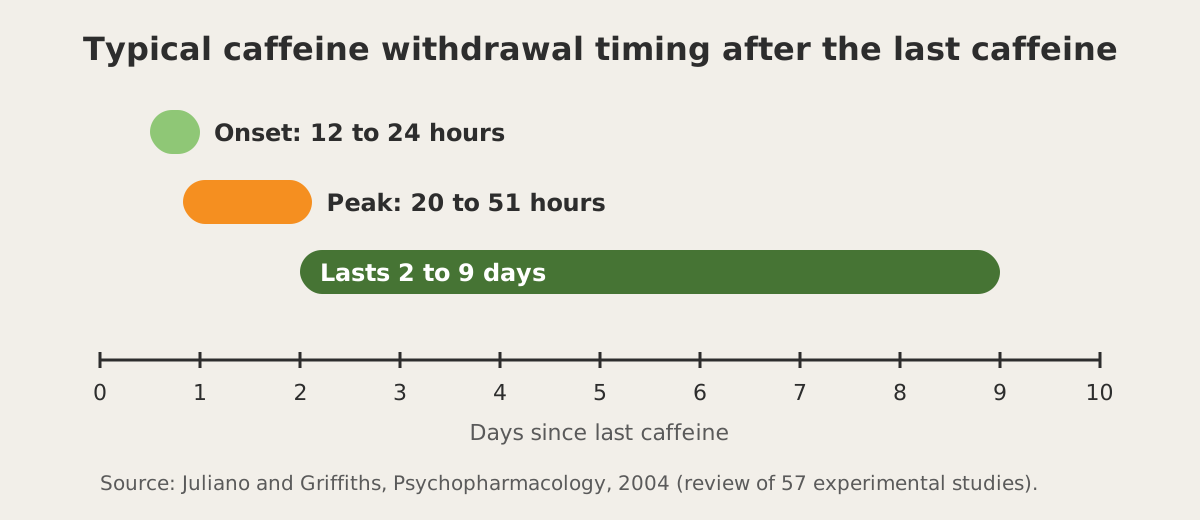
Typical caffeine withdrawal timing from the Juliano and Griffiths review. Individual experience varies.
What happens on days 2 to 9 when you quit soda cold turkey?
This is the window where it can feel rough, if it’s going to. The same review found peak intensity at 20 to 51 hours, and a total duration of 2 to 9 days.
Which symptoms are real? Of 49 symptom categories studied, the review judged ten to meet its validity criteria: headache, fatigue, decreased energy, decreased alertness, drowsiness, decreased contentedness, depressed mood, difficulty concentrating, irritability, and feeling foggy or not clearheaded. It also judged flu-like symptoms, nausea or vomiting and muscle pain or stiffness likely to be valid.
Two numbers help keep this in proportion (drawn below). In experimental studies, headache occurred in about 50 percent of people, and clinically significant distress or impairment in 13 percent. So if you quit soda cold turkey, a rough couple of days is plausible, and a fine one is just as plausible.

Incidence in experimental studies of caffeine withdrawal. Source: Juliano and Griffiths, 2004.
Dose matters, too. The review found incidence and severity generally rose with higher daily doses, and that abstinence from doses as low as 100 mg a day produced symptoms in some people. The FDA lists caffeinated soft drinks at 23 to 83 mg per 12 ounces, so a few cans a day can reach that range. For the detail on the headache, see our caffeine headache guide, and for the longer picture the caffeine withdrawal timeline.
One more thing. A soda without caffeine won’t produce this at all. Then what you’re getting is only the habit part.
What happens to cravings and mood after quitting soda?
Here the honest answer is: it depends on what the soda was doing for you.
If it was a three o’clock reward, the craving arrives at three o’clock, whatever your blood chemistry. It follows the cue. That’s why swaps work better than willpower: you’re changing what happens at the cue. The sugar cravings post goes into this.
Some people say that after a few weeks sweet drinks taste sweeter and soda tastes sickly. I hear it a lot, and I believe the people saying it. But I haven’t found a solid source that measures it for soda, so treat it as common experience, not established fact.
What about the longer term? Weeks and months
Let’s be careful here, because this is where headlines overreach.
According to the CDC, the leading sources of added sugar in the American diet include sugary drinks, and drinking too many of them is associated with weight gain, type 2 diabetes, high blood pressure and tooth decay. The NHS says plainly that sugar is one of the main causes of tooth decay. Those are population-level associations, and they describe risk, not a personal forecast.
So the fair way to say it: drinking less sugary soda lowers your exposure to things that are linked to those outcomes. It doesn’t guarantee any outcome, and it isn’t a treatment for anything. If you have a condition, your doctor is the right person to talk to. I’ve written separately about the benefits of quitting soda, including which are well supported and which are hopeful.
What happens week by week? A simple map
| When | What’s documented | What’s habit |
|---|---|---|
| First 12 hours | Usually no withdrawal yet | Reaching at your usual moments |
| 12 to 24 hours | Caffeine withdrawal may begin | Cravings at lunch, afternoon, drive home |
| About 1 to 2 days | Peak intensity (20 to 51 hours) | Headache, fogginess, low mood possible |
| Days 2 to 9 | Withdrawal fades, typical range | Routine slowly re-forming around swaps |
| Weeks 2 and on | Sugar intake stays lower than before | New defaults, and the odd slip |
How do I get through the first week of quitting soda?
A few practical things, none of them clever.
- Know the window. If it’s day two and you feel off, remember that the research puts the peak there. It’s a bad two days, not a bad you.
- Mind the sources of caffeine. If you swap a cola for nothing, you’re removing a dose. A cup of tea or coffee at the usual hour is a perfectly reasonable way to ease down. See quitting caffeine cold turkey for the trade-offs.
- Stock a swap for each moment. Unsweetened iced tea, seltzer with lime, cold brew. Whatever you’ll actually pick up.
- Don’t treat a slip as a reset. One can is one can.
If you’d rather taper than stop overnight, nothing says you can’t. A smaller drop in caffeine is generally a gentler one, though I’d rather not overstate it: the review shows withdrawal rising with dose, not that a taper prevents it. In FizzFree, the Taper Dial lowers your weekly allowance step by step, and Ride the Fizz gives you a 90-second craving exercise: hold a finger down, watch the bubbles rise, lift on a slow breath and they pop.
That quit soda tracker also keeps the invisible part visible. The Sugar Jar stacks the sugar you skipped as cubes, and FizzFree has no streak, so one slip doesn’t erase anything. Check-ins, goals and notes stay on your phone. The how it works page shows the first check-in. I’m John Osakwe, founder of FizzFree Labs, and this is why I built it.
Is quitting soda a detox?
No, and I’d steer away from the word. “Soda detox” gets searched a lot, but cutting sugary drinks isn’t a medical detox. There’s nothing to flush. You’re changing a habit and, if your drink had caffeine, coming off a regular dose of it. That’s all, and it’s enough to take seriously without dressing it up.
FAQ
What happens when you stop drinking soda every day? Two things change at once: you stop taking in the sugar, and if your soda has caffeine, you may feel a short withdrawal. A major 2004 review found symptoms usually start 12 to 24 hours after the last caffeine and last roughly 2 to 9 days.
Will I get a headache if I quit soda cold turkey? Maybe. In the experimental studies reviewed by Juliano and Griffiths, about half of people had a headache when they stopped caffeine. Sodas without caffeine don’t cause it, and cutting down in steps makes each drop smaller.
How long do the effects of quitting soda last? Caffeine withdrawal typically runs 2 to 9 days in the research. Habit-driven cravings follow your routine, so they tend to show up at your usual drinking moments and fade as new routines settle in. There’s no fixed date.
Is quitting soda a detox? No. Cutting sugary drinks is not a medical detox. Your body doesn’t need a cleanse; you are simply changing a habit and, for caffeinated drinks, coming off a regular dose of caffeine.
What happens when you stop drinking Coke? The same as any caffeinated soda: less sugar, and possibly mild caffeine withdrawal. The FDA lists caffeinated soft drinks at 23 to 83 mg of caffeine per 12 ounces, so a few cans a day can add up to a dose your body notices when it stops.
Sources: Juliano and Griffiths, Psychopharmacology 2004; CDC, Be Smart About Sugar; FDA, Spilling the Beans; NHS, How does sugar in our diet affect our health?

I'm John Osakwe, founder of FizzFree Labs, the company behind the FizzFree app for quitting or cutting down soda and energy drinks. I also run Etest Tech Hub in Lagos, Nigeria, where we build mobile apps.
FizzFree is a habit tracker and not medical advice. If you have a health condition or take medication, talk to your doctor before changing what you drink.