
Search “is Diet Coke bad for you” and you’ll get two kinds of answers. One says it’s basically water with colour. The other says it’s poison in a can. Neither one is what the evidence shows.
So here’s the plain version. Diet Coke has no sugar and no calories on its label, it contains a sweetener (aspartame) that regulators have reviewed many times, and the long-term research on diet drinks is genuinely mixed. That’s a less exciting answer than either headline, but it’s the honest one.
Quick answer: Nothing on the Diet Coke label is a red flag by itself: 0 calories, 0 g sugar, 40 mg sodium and 46 mg caffeine per 12 fl oz can. Regulators disagree slightly about aspartame, and long-term studies on diet drinks are inconclusive. It’s a better choice than sugary soda, not a health drink.
Key takeaways
- A 12 fl oz can lists 0 calories, 0 g sugar, 40 mg sodium and 46 mg caffeine.
- The FDA, JECFA and IARC looked at aspartame in 2023 and did not reach the same conclusion in the same words.
- Studies linking diet drinks to health outcomes are mostly observational, so they can’t prove cause.
- Harvard’s Nutrition Source treats diet soda as a possible short-term step down from sugary soda.
What’s the nutritional value of Diet Coke?
Let’s start with the label, because it’s the one thing that isn’t up for debate. Coca-Cola’s US product page for Diet Coke lists these numbers for a 12 fl oz can:
| Per 12 fl oz can | Diet Coke | Coca-Cola Original |
|---|---|---|
| Calories | 0 | 140 |
| Total sugars | 0 g | 39 g |
| Sodium | 40 mg (2% Daily Value) | not listed for the can on the page |
| Caffeine | 46 mg | 34 mg |
 Source: Coca-Cola US product pages, 12 fl oz can. Figures can change if the recipe or country changes.
The “nutritional value of Diet Coke” is, bluntly, close to nothing. No protein, no fat, no carbohydrate, no vitamins to speak of. It’s flavoured, carbonated water with a sweetener. That cuts both ways: it isn’t adding sugar to your day, and it isn’t adding nutrients either.
One detail surprises people. Diet Coke has more caffeine than regular Coke on the label, 46 mg against 34 mg. It’s still well below a typical cup of coffee, but if you’re watching caffeine, it’s worth knowing. If caffeine is your real worry, our guide to caffeine withdrawal symptoms covers what changes when you cut back.
What’s actually in a can: ingredients and sweeteners in Diet Coke
The ingredient list on the US label starts with carbonated water, caramel color and aspartame, followed by phosphoric acid, with potassium benzoate, natural flavors, citric acid and caffeine also listed. There’s also the line for people with phenylketonuria: “contains phenylalanine.”
Here’s what each does, in plain terms:
- Aspartame is the sweetener. Harvard’s Nutrition Source says it’s about 200 times sweeter than table sugar, which is why so little is needed.
- Caramel color gives the cola its brown.
- Phosphoric and citric acids add tartness.
- Potassium benzoate is a preservative.
So when people ask about the sweeteners in Diet Coke, the one on the US label is aspartame. That’s the ingredient the headlines are about, so let’s look at it properly.
Is aspartame in Diet Coke safe? What the FDA, WHO and IARC said
In July 2023 two bodies published on aspartame on the same day, and it caused plenty of confusion. According to the World Health Organization, the International Agency for Research on Cancer (IARC) classified aspartame as “possibly carcinogenic to humans (Group 2B),” based on limited evidence, specifically for liver cancer in people. Meanwhile JECFA, the expert committee of the Food and Agriculture Organization and WHO, kept its acceptable daily intake (ADI) at 0-40 mg per kg of body weight.
Those two statements sound opposed. They aren’t, quite. IARC asks whether something could cause cancer at all, under any exposure. JECFA asks how much is acceptable in daily life. WHO’s own summary puts the second point in terms of cans: an adult weighing 70 kg would need to drink more than 9-14 cans a day to go over the ADI, assuming no aspartame from anywhere else.
The FDA took a firmer line. It says its scientists “do not have safety concerns when aspartame is used under the approved conditions,” and it sets the ADI at 50 mg per kg of body weight, slightly higher than JECFA’s. The agency disagrees with IARC’s classification, saying it found significant shortcomings in the studies IARC relied on. It also notes that JECFA raised no safety concerns at current levels of use.
Both WHO officials quoted in the release, by the way, called for better research. IARC’s Dr. Mary Schubauer-Berigan said the limited evidence underscores “the need for more research,” and JECFA’s Dr. Moez Sanaa asked for “better studies with longer follow-up.”
My own read, and it’s only that: the sensible conclusion is “no alarm, not fully settled.” Anyone who tells you the question is closed in either direction is going further than the agencies do.
What about diet soda and your kidneys?
This is a question people ask a lot, so it deserves a careful answer rather than a scary one.
The study everyone cites comes from the Nurses’ Health Study. Researchers Lin and Curhan followed more than 3,000 women, and published in the Clinical Journal of the American Society of Nephrology in 2011. Women who drank at least two servings a day of artificially sweetened soda had about twice the odds of a 30% or greater drop in kidney filtration (odds ratio 2.02). Fewer than two servings a day showed no increased risk, and sugar-sweetened soda showed no association.
The authors are blunt about the limits. They wrote that causality can’t be established from an observational cohort. The data don’t say which sweeteners or brands people drank. The group was mostly older white women, so it may not apply to everyone. And diet soda intake might simply mark other risk factors the study didn’t capture.
So: a signal worth following up, not a verdict. If you have kidney disease or any kidney concern, what you drink is a question for your own doctor, not for a blog.
What does the wider research say about diet drinks?
Zoom out and the picture is, frankly, muddy. Harvard’s Nutrition Source states that “the health effects of low-calorie/artificial sweeteners are inconclusive, with research showing mixed findings.” It lists some proposed mechanisms (changes in gut bacteria seen in animal studies, a possible effect of sweet taste on insulin) and labels them “hypothetical and not proven in human studies.”
WHO’s 2023 guideline on non-sugar sweeteners is more cautious. It recommends against using them to control body weight or reduce the risk of noncommunicable diseases, rating that recommendation as conditional. Its review found no long-term benefit for body fat in adults or children, and suggested possible long-term harms, including higher risk of type 2 diabetes and cardiovascular disease, from observational data. WHO itself notes those links may be confounded by people’s baseline characteristics. The guideline excludes people who already have diabetes.
Why can’t studies settle this? Mainly because of who drinks diet soda. People often switch to it because of a health concern, which can make diet drinks look worse than they are. That’s called reverse causation, and it’s hard to untangle without randomized studies, which are exactly what JECFA’s Dr. Sanaa asked for.
So is Diet Coke bad for you, or just not good for you?
Here’s a way to hold all of this at once.
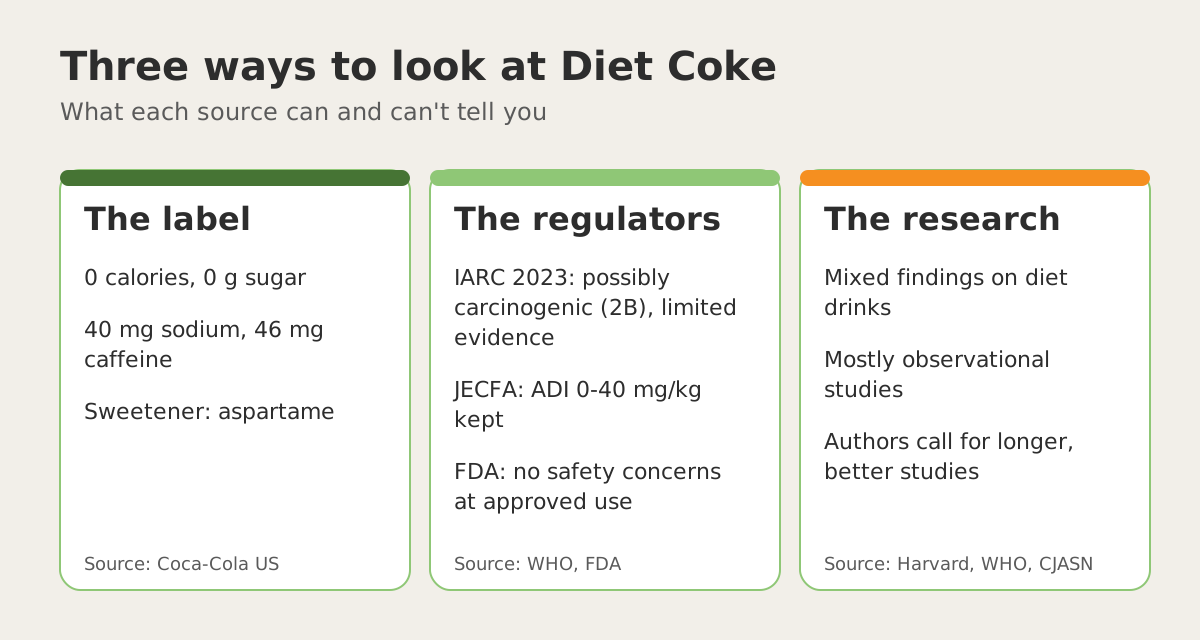 Summary of the sources cited in this post. Not a safety ranking.
- The label is simple: no sugar, no calories, modest caffeine and sodium.
- The regulators don’t see a safety problem at normal intake, but they don’t fully agree on the details.
- The research can’t yet say whether regular diet soda helps or hurts over decades.
For someone swapping out three sugary sodas a day, Harvard calls diet soda “a possible short-term substitute, best used in small amounts over a short period of time.” That fits the AHA/ADA framing the same page quotes: a useful temporary replacement strategy. The Nutrition Source’s top picks are water, and coffee or tea without added sweeteners.
If you want the cut-down angle specifically, we cover it in how to quit diet soda, and the sweetener question in more depth in diet soda without aspartame.
How can I see my own Diet Coke habit clearly?
The most useful thing isn’t a verdict from the internet. It’s knowing how much you actually drink, and when. Two cans on a bad Tuesday is a different pattern from four every day at 3 pm.
That’s the thing a simple quit soda tracker is good for. FizzFree is a habit tracker from FizzFree Labs, and you can choose diet soda as your drink in setup. You do one calm daily check-in, and the Fizz Map lets you name the moments you reach for a can, with a quiet nudge ten minutes before. It’s not medical anything. It just turns “I think I drink a lot” into a pattern you can see. You can read how it works on the how it works page.
Frequently asked questions
How many calories are in a can of Diet Coke? Coca-Cola’s US page lists 0 calories, 0 g sugar and 40 mg sodium for a 12 fl oz can, plus 46 mg caffeine.
Does Diet Coke cause cancer? IARC called aspartame “possibly carcinogenic” on limited evidence in 2023, while JECFA left its ADI unchanged and the FDA reports no safety concerns at approved use. Neither says a can causes cancer.
Is diet soda bad for your kidneys? One observational study found higher odds of kidney function decline in women drinking two or more servings a day. The authors say it can’t show cause and effect.
Is Diet Coke better than regular Coke? On sugar and calories, yes: 0 against 39 g and 140 calories per can. Harvard sees it as a short-term step down, not a goal.
Who should avoid aspartame? According to the FDA, people with PKU should avoid or limit it. Ask your doctor about anything beyond that.
Sources
- Coca-Cola US: Diet Coke product page (nutrition, caffeine, ingredients)
- Coca-Cola US: Coca-Cola Original product page
- WHO: Aspartame hazard and risk assessment results released (14 July 2023)
- FDA: Aspartame and Other Sweeteners in Food
- Harvard T.H. Chan Nutrition Source: Low-Calorie Sweeteners
- Lin and Curhan, CJASN 2011: Sugar and artificially sweetened soda with albuminuria and kidney function decline in women

I'm John Osakwe, founder of FizzFree Labs, the company behind the FizzFree app for quitting or cutting down soda and energy drinks. I also run Etest Tech Hub in Lagos, Nigeria, where we build mobile apps.
FizzFree is a habit tracker and not medical advice. If you have a health condition or take medication, talk to your doctor before changing what you drink.