
Here’s the argument I hear most from people who drink diet soda: it’s zero sugar and zero calories, so what’s the harm? It’s a fair thing to say. It’s also not quite the right question.
The better question is whether the diet soda is doing something for you that you’d rather it didn’t, and whether you want to do without it. If the answer is yes, this is how to quit diet soda, including Diet Coke, with a ladder you can step down instead of a cliff you jump off. And if the answer is no, that’s a perfectly respectable answer too.
Quick answer: To quit diet soda, identify what it gives you: fizz, sweetness, caffeine or a habit moment. Then step down by swapping to sparkling water, lowering sweetness gradually, and handling caffeine with a taper or clean stop. Caffeine withdrawal, if it comes, typically lasts about 2 to 9 days.
Key takeaways
- Diet soda has no sugar but can keep the sweetness, the fizz, often caffeine and the routine.
- WHO recommends against using non-sugar sweeteners to control body weight, but that’s not a promise about what quitting does.
- If your diet soda has caffeine, expect a possible withdrawal window of about 2 to 9 days.
- Stepping down works better than white-knuckling for most people.
- Nobody can honestly guarantee a health result from quitting; talk to your doctor if you have a condition.
Why quit diet soda at all? Reasons people give
I’m not here to tell you diet soda is poison. It isn’t, and I’d be inventing evidence if I said so. For a fuller look at the evidence read is Diet Coke bad for you and our piece on zero sugar soda.
Here’s what’s on the record. In May 2023, the World Health Organization issued a guideline that “recommends against the use of non-sugar sweeteners to control body weight.” Its review found that replacing sugars with non-sugar sweeteners “does not help with weight control in the long term,” and flagged possible harms from long-term use, including a higher risk of type 2 diabetes, cardiovascular disease and mortality in adults. WHO rated the recommendation “conditional” because the observed links may be confounded, so this is guidance with caveats, not a verdict. It excludes people with pre-existing diabetes.
WHO’s Francesco Branca also said people should “reduce the sweetness of the diet altogether.” That line is, to my mind, the most useful part for anyone trying to quit.
Common reasons people give for quitting are practical:
- They want less sweetness in their day.
- They notice a caffeine dependence they’d rather not have.
- It’s a trigger for a snack or a sweet craving.
- They want one fewer thing to buy and carry.
Pick yours. It shapes the plan.
What does diet soda actually give you?
Before you cut it, know what you’re replacing. Diet soda usually bundles four things:
| What it gives you | Does it need a replacement? |
|---|---|
| Fizz | Yes, and this is the easy one: sparkling water |
| Sweetness | Maybe, and this is the harder part |
| Caffeine (many, not all) | Possibly a taper; see below |
| A moment (lunch, 3 pm, the drive home) | Always. A swap for the moment |
If you can name the main one, you’ve done half the work.
What happens when you stop drinking diet soda?
Honestly: it depends on which of those four you were relying on.
The caffeine part is the most predictable. The FDA lists caffeinated soft drinks at 23 to 83 mg per 12 ounces, and 400 mg a day is the amount it says is not generally associated with negative effects for most adults. If you drink several cans a day, you’re taking a real dose. In their 2004 review, Juliano and Griffiths found that withdrawal symptoms typically start 12 to 24 hours after the last caffeine, peak at 20 to 51 hours and last about 2 to 9 days, with headache in around half of people in experimental studies. A decaf diet soda won’t do this. For the detail see caffeine withdrawal symptoms and the caffeine withdrawal timeline.
The sweetness part is less measured. People say plain things start to taste better and diet soda tastes odd after a while. I believe them, but I haven’t found a solid source that measures it, so take it as reported experience.
The weight part has no promises. The “quit diet soda, lose weight” idea is popular. What WHO says is that sweeteners aren’t a proven long-term tool for body weight. That doesn’t mean quitting will change yours. Other habits shift at the same time and individuals differ. I’m not making that claim, and I’d be wary of any article that does.
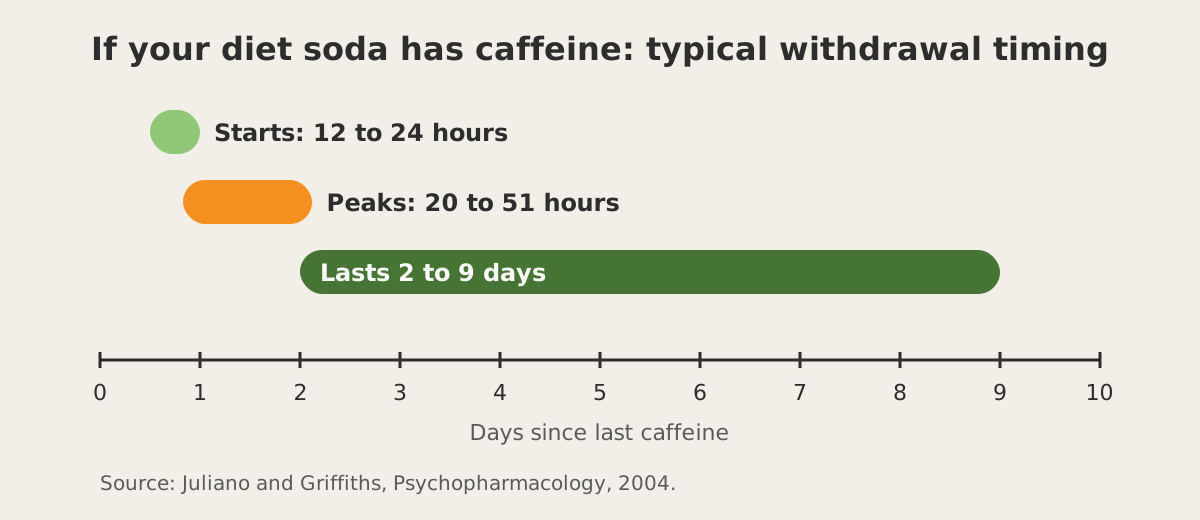
Typical caffeine withdrawal timing, relevant if your diet soda has caffeine. Source: Juliano and Griffiths, 2004.
How do I quit diet soda step by step? The ladder
A cliff says “stop today.” A ladder says “go down one rung at a time, and you can stand on a rung for a while.” Choose the version that fits your week.
- Name your moments. For one week, write down when you reach for a can. Not how many. When.
- Swap the fizz first. Plain sparkling water, or seltzer with lime. This keeps the sensation you actually like, and takes the least willpower.
- Turn the sweetness down. Move to sparkling water with a splash of unsweetened tea, or a slice of citrus, then to plain. This is WHO’s “reduce the sweetness altogether” in practice.
- Handle the caffeine on purpose. If your diet soda has caffeine, decide: a clean stop, or a smaller dose in steps (a cup of tea in the afternoon, say). Research shows withdrawal rising with dose, but not that tapering prevents it, so go in knowing a rough day or two is possible either way.
- Plan the slip. You’ll have a can some day. One fizz day is not a reset.

The step-down ladder. Spend as long as you need on each rung.
How do I stop Diet Coke specifically?
Diet Coke, Coke Zero, Pepsi Max and the rest all follow the same logic. The brand doesn’t change the plan; the four things above do. A few notes people ask about:
- If it’s the 3 pm can: put the swap in the fridge at lunch. Our guide to how to stop drinking soda goes through moments and swaps in detail.
- If it’s the fizz: consider the healthiest sparkling water options, or diet soda without aspartame as a stepping stone if you’re not ready to drop sweetness yet.
- If it feels like an addiction: that’s usually caffeine and habit, with sweetness a more debated third. Our soda addiction post separates them.
What if I’m worried about my health?
If you have a health condition such as diabetes, or you take medication, ask your doctor before changing what you drink. WHO’s guidance specifically excludes people with pre-existing diabetes, and an app or a blog is no substitute for advice that fits you.
Can an app help me quit diet soda?
A soda tracker can handle the logistics so you don’t have to. FizzFree, from FizzFree Labs, covers diet soda as one of the drinks you can choose in setup. The Fizz Map names your moments and sends a quiet nudge 10 minutes before. The Swap Shelf is your own fridge of replacements, and you tap whether each swap worked. The Taper Dial lowers your weekly allowance step by step, which suits the ladder above. Ride the Fizz is a 90-second craving exercise. There’s no streak to lose, no account, and check-ins, goals and notes stay on your phone. Here’s how it works. I’m John Osakwe, the founder, and I’d like the app to treat a slip the way I’d treat a friend’s.
FAQ
What happens when you stop drinking diet soda? You lose a regular source of intense sweetness and, if it has caffeine, a regular dose. Caffeine withdrawal typically starts 12 to 24 hours after the last dose and lasts about 2 to 9 days, according to a major review. Beyond that, results vary and nobody can promise specific health changes.
Will I lose weight if I quit diet soda? There’s no promise. WHO’s 2023 guideline recommends against using non-sugar sweeteners to control body weight and found no long-term benefit for body fat, but that is about sweeteners as a weight tool. Quitting diet soda may change other habits too, and results differ.
Is diet soda addictive? It can feel that way. Three things are at play: caffeine dependence (documented), the pull of sweetness, and the habit tied to a time or place. Whether sweetness itself is addictive in humans is debated.
Should I switch to water or sparkling water? Sparkling water is a natural landing spot because it keeps the fizz. Many people add citrus or a splash of unsweetened tea to bridge the gap in flavour.
Is it OK to drink diet soda sometimes? That’s a personal and a medical question. WHO’s advice is aimed at regular use for weight control and doesn’t apply to people with existing diabetes. If you have a health condition, ask your doctor.
Sources: WHO, advises not to use non-sugar sweeteners for weight control; Juliano and Griffiths, Psychopharmacology 2004; FDA, Spilling the Beans
I'm John Osakwe, founder of FizzFree Labs, the company behind the FizzFree app for quitting or cutting down soda and energy drinks. I also run Etest Tech Hub in Lagos, Nigeria, where we build mobile apps.
FizzFree is a habit tracker and not medical advice. If you have a health condition or take medication, talk to your doctor before changing what you drink.